

Japan Annoys China with Reality
Takaichi demonstrates leadership that augments U.S. security in the Pacific.


Japanese Prime Minister Sanae Takaichi has wasted no time asserting her leadership and has done something bold by the standards of allied East Asian diplomacy: she stated the truth.
Katsuya Okada, a pacifist opposition member of Japan’s House of Representatives, asked Takaichi during a Budget Committee meeting how a Chinese move on Taiwan would affect Japan. Specifically, he asked, “If the strait between Taiwan and the Philippines were blockaded, would that constitute a survival-threatening situation?”
Takaichi replied: “If warships are used and it involves the use of force, then however you look at it, it could constitute a survival-threatening situation.”
The repeated phrase is important because it is the threshold at which Japan could legally engage in “collective self-defense,” which means cooperating with the United States and other allies in wartime conditions.
In effect, she is the first Japanese prime minister to state relatively clearly a basic assumption of Pacific security: that Japan cannot avoid involvement if China invades or blockades Taiwan, which is less than 400 miles from the important Japanese island of Okinawa. (As I argue later, another assumption is that the United States cannot help Taiwan without the assistance of treaty allies Japan and the Philippines.)
Takaichi’s relatively concise answer is a change for Japan, and a smart one. While ambiguity can provide leaders more options in a crisis, it can also cause wishful thinking and the breakdown of deterrence. Clarity frames the minds of friends and foes for what must be done before and during a potential conflict.
Takaichi’s answer was particularly obvious given how Okada framed the question: China not only tightly encircling Taiwan and closing the Taiwan Strait, but also the Luzon Strait on the other side of Taiwan that stretches to the northern Philippines. In this scenario, China would effectively dominate the South China Sea and isolate Japan and the United States from the rest of Asia.
China’s response has lacked nuance. A Chinese Foreign Ministry spokesman said:
Japan must immediately correct its mistakes and withdraw these egregious remarks, otherwise all consequences will be borne by Japan… If Japan dares to militarily intervene in the Taiwan Strait situation, it will constitute an act of aggression, and China will deliver a head-on and severe blow.”
On Monday, a spokesman went further, saying Japan must “Stop crossing the line and playing with fire, retract the wrongful remarks and deeds and honor its commitments to China with real action.
Going further still, China’s consul general in Osaka, Xue Jian, threatened Takaichi by posting, “The dirty neck that sticks itself in must be cut off.”
The angst was like Judy Garland died all over again. And these are the pleasant chaps on whom our former elite decided to make us economically dependent.
The Chinese diplomat’s threat brought a rebuke from U.S. Ambassador to Japan George Glass. Any diplomat posted to America who said something like that about President Trump would likely be expelled by Secretary of State Marco Rubio, preferably by way of Alligator Alcatraz.
However, Tokyo has tried to calm matters down. It sent a senior diplomat, Masaaki Kanai, to Beijing on Monday. Most reliable analysts believe that Takaichi’s comment was not planned but was her true feeling and was given an unexpected outlet.
Some might say it was a gaffe since it prompted a crisis, but I would call it leadership.
For years, many Japanese scholars and diplomats have expressed a desire for Japan to be an equal partner in its alliance with the United States. Some of Takaichi’s predecessors as prime minister, especially Shinzo Abe, shared this view. But the question back to the Japanese was, “Okay, what would you do differently?” And the advice was often to move beyond discussing a greater role to just playing one.
Japan has done this. In the past decade, it has taken steps to revise the interpretation of the pacifist constitution the United States imposed on Japan during the postwar occupation—a move debated on and off since the 1950s and supported in recent decades by Washington. Tokyo also decided to double its defense budget and reorient its military to deter China specifically.
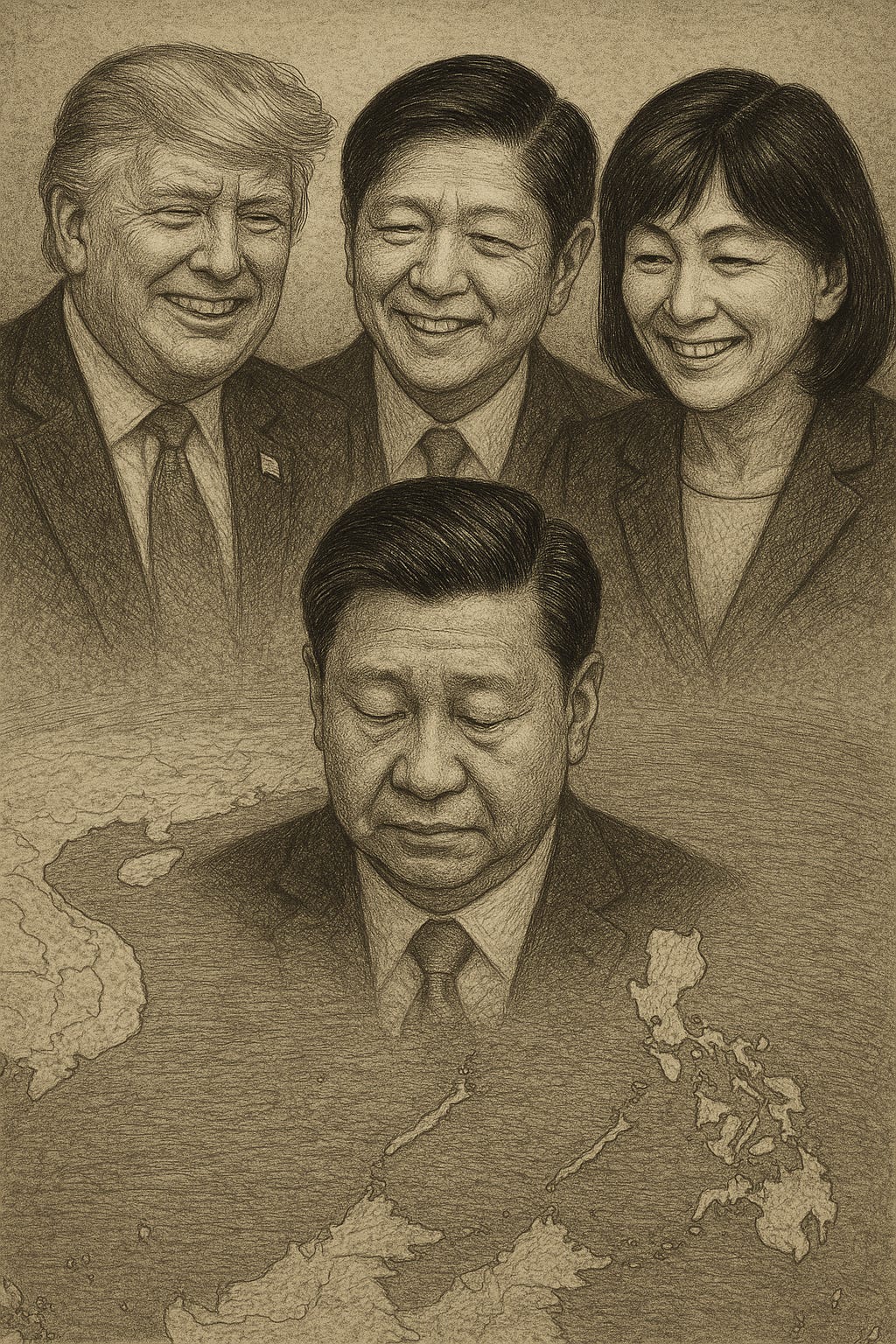
Takaichi has merely explained part of the reality behind these moves—a reality centered on prospective Chinese military aggression against peaceful democracies. China does not like that Takaichi drew a line under the reality that China is the problem. It is China, not Japan, that seems to be preparing to undermine the peace and security that has prevailed in the Western Pacific since 1945.
This reality is evident from the low-intensity conflict China is already waging against the Philippines at sea and the increasingly common Chinese circumnavigation of Taiwan by warplanes and warships. That looks a lot like a dress rehearsal for a blockade.
On November 10, Laura Ingraham asked President Trump about the hubbub on Fox News. Trump’s response: “These people [China] are not our friends, right? Many of our allies are not our friends either… our allies have taken advantage of us even more than China has.”
China’s state-controlled media has celebrated this as a refusal to back Takaichi. I believe that is wishful thinking.
Trump’s interview centered more broadly on trade with China and immigration, including controversial H-1B visas that many contend take good jobs from Americans while creating an immigration chain. Trump was defending his support for continuing some H-1B visa issuance even after his administration has placed the substantial hurdle of a $100,000 fee on the visa type. In other words, the broader context of his interview was defending his actions related to China. It is also unclear whether he was directing his criticism of allied trade at Japan or Taiwan, the latter of which he has correctly accused of stealing U.S. semiconductor technology to gain a dominant market position.
Take a step back, and Takaichi’s statement fits well with what Trump is seeking from allies: that they take more responsibility for security. Given the gradual and nuanced speed of change in Japanese policy—a reflection of the Japanese character—Takaichi’s statement is a big leap for Japan and for Pacific security.
The move also creates more space for Trump’s good-cop–bad-cop diplomacy with China. At the opposite end of the spectrum of what annoys China or doesn’t is the election of a new leader of the opposition KMT party in Taiwan, Cheng Li-wun. She has prioritized “peace with China,” sought expanded ties between China and Taiwan, and even called for “a grand new chapter for the rejuvenation of the Chinese nation”—about as far as one can get from calling for Taiwanese independence.

Given the unpopularity of Taiwan’s woke and progressive incumbent DPP party, which will have governed for an exhausting twelve years by the next election in 2028, the KMT has a reasonable shot at taking power—especially given recent success at the polls. China has a strong incentive not to alter this natural political swing.
All of this is occurring against a broader new look at national defense in the United States. Trump has been tougher on China than any president since Dwight Eisenhower, but the reality of dealing with China militarily is becoming clearer in Washington. Abandoning former President Joe Biden’s de facto Europe-first foreign policy and shifting emphasis to the Pacific both help deter war with China. But should Beijing blockade Taiwan or invade the island, the difficulty for the United States and its allies to break the blockade will be great.
Not only has China expanded its military power significantly, the tyranny of geography in the Pacific comes into play (see map). Important U.S. Navy bases in Honolulu and San Diego are, respectively, 5,150 and 7,050 miles from Taiwan. China has procured weapons specifically designed to make an approach by one or several U.S. aircraft carrier groups toward Taiwan extremely dangerous.
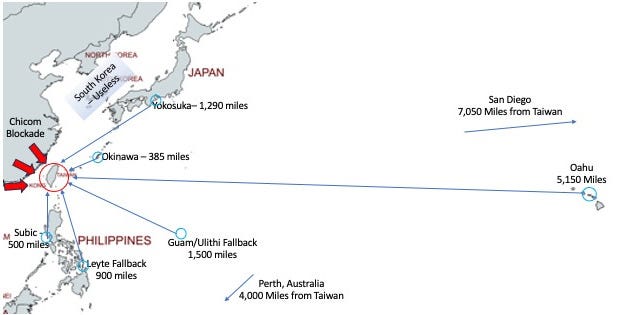
In reality, it would take the bulk of the entire U.S. military to attempt a rescue of Taiwan. It would also take allies, especially Japan and the Philippines, which would be indispensable as staging areas for any allied move. (South Korea is technically a U.S. treaty ally but I believe it would decline to help much in a U.S.–China fight.)
The United States closed major military bases in the Philippines after the Cold War, but it has retained a military and political relationship. That relationship grew significantly when President Bongbong Marcos, the current pro-U.S. Philippine leader, took office in 2022. Washington and Manila have also established nine modest joint military bases in the Philippines in recent years.
With the Philippines showing renewed determination to resist China, Takaichi snapped in place another piece of the puzzle by indicating Japan’s intent.
During World War II, the United States considered invading Taiwan, which was then occupied by Imperial Japan. “Operation Causeway” would have bypassed Japanese-held Okinawa and the Philippines and used Taiwan as the staging ground for an invasion of the Japanese home islands. It was abandoned when U.S. military leaders realized that attempting this move with Okinawa and the Philippines under enemy control would be too risky. Instead, Washington decided to liberate the Philippines and invade Okinawa.
Today, this logic still applies and can be used in reverse. With Japan (including Okinawa) and the Philippines in alliance with the United States, a move on Taiwan by China, despite its proximity, would be risky.
Takaichi has made this riskier still—for which we should be grateful.
Christian Whiton was a State Department senior advisor in the second Bush and first Trump administrations. He served as a deputy special envoy for North Korean human rights issues and advised the secretary of state and other senior officials about public affairs and East Asia matters. During the 2016–2017 Trump transition, he aided in the confirmation of the secretary of state and other senior department officials. He is a senior fellow at the Center for the National Interest and a principal at Rockies Aria LLC, a public affairs and government relations firm. He previously worked for KPMG LLP, Fidelity Investments, and Oppenheimer & Co.
The author of “Smart Power: Between Diplomacy and War,” Christian co-hosts the “Domino Theory” podcast and edits “Capitalist Notes” on Substack. He frequently has appeared on Fox News, Fox Business, Newsmax, BBC, CNN, , NHK, Sky News Australia, CNBC, MSNBC, and numerous other outlets. In addition to the National Interest, his articles have been published by Fox News Opinion, the Daily Caller, The Wall Street Journal, the Australian, and others. Mr. Whiton has a BA from Tulane University and an MBA from the University of California, Los Angeles.
Spot on. Excelent analysis. How do you see this clarity afecting long-term regional stability?
China has to bluster here. They have to know that Japan could start canning its own sunshine anytime it felt like acquiring the fissionables...which could probably be had with a phone call to Dimona brokered by President Trump.