

Japan at a Crossroads: Takaichi
Plus: No One Cares About Pentagon Media Pouting

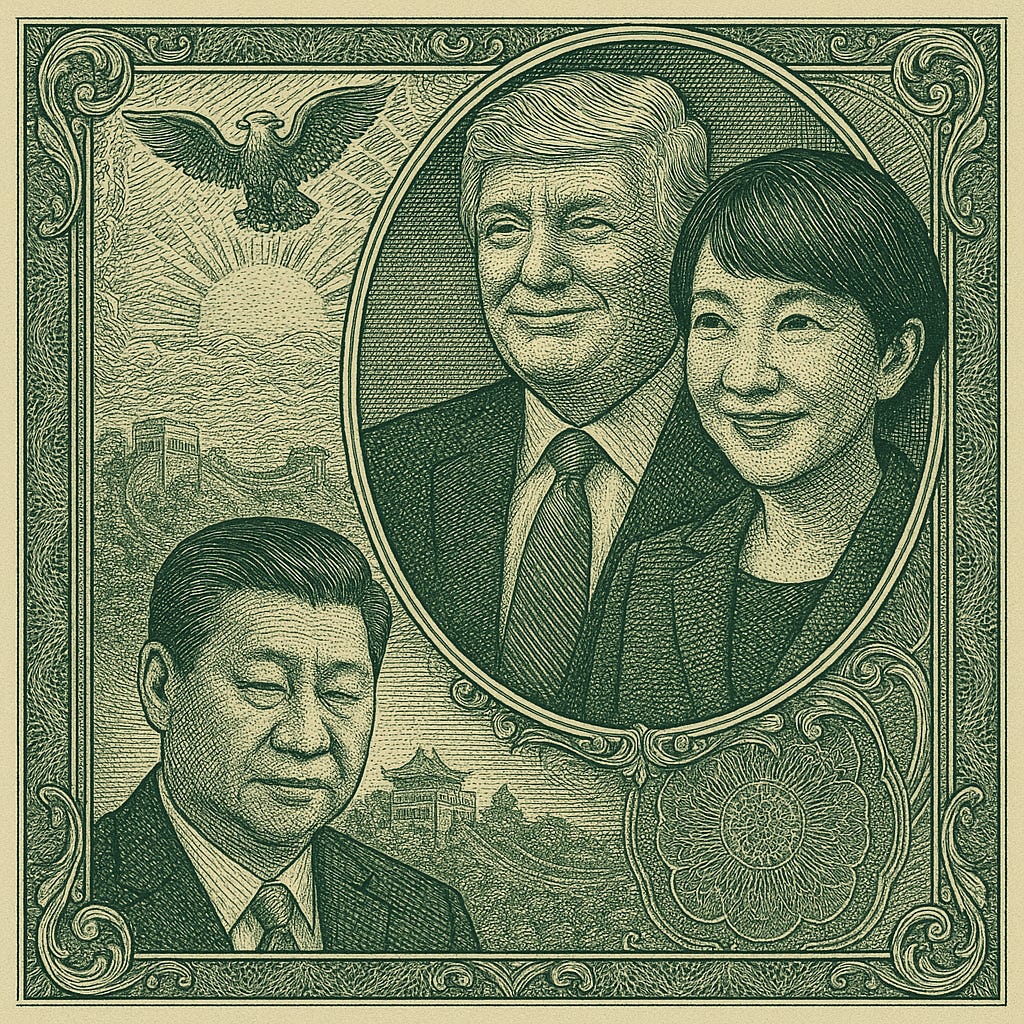
As usual for the last century or so, events in Asia that can significantly affect U.S. economic and security interests aren’t getting the attention they deserve.
To the extent the news is focused on Asia, it is mostly about China’s failed attempt to strong-arm President Donald Trump in the trade war by using rare-earth metals. Related to this is whether Trump will meet with Chinese ruler Xi Jinping at the APEC summit that begins on Halloween in South Korea. (Spooky—he will.)
But a matter crucial to America’s most important ally in the world, Japan, will take place next Tuesday and represents a juncture for Japan and the USA.
On that day, the Japanese Diet, as their parliament is deliciously called, will consider making Sanae Takaichi prime minister. She previously won election as head of the largest and nearly invariably ruling party in Japan, the Liberal Democratic Party (LDP), which thankfully isn’t particularly “liberal” or “Democratic” in the American sense.
Ordinarily this would make her prime minister without question, but the LDP currently requires coalition partners to assemble a majority in each house of the Diet—a reflection of unease among the Japanese public over recent economic developments and the party that has governed Japan for all but four years since its founding in 1955.
Ordinarily, the girl-power DEI gang in the U.S. media, plus its equally progressive and pointless English-language cousins around the Pacific (exception: The Australian), would be jumping at the prospect of Japan’s first woman prime minister.
True, Japan has had reigning empresses. The last, Go-Sakuramachi, abdicated in 1771. But for much of the 900 years until the modern era, shoguns held most governing power, while the imperial court’s role was more or less ceremonial.
Takaichi would be the first woman leader in modern history, and the first who is premier in name and practice. While there has been some coverage of this potential watershed, it has been muted.
The reason is simple: Takaichi is a pro-capitalist, pro-America, skeptical-of-the-Chicoms protégé of assassinated Shinzo Abe, who during his second tenure as Japan’s prime minister committed the cardinal sin of having the closest and most consequential foreign-leader relationship with Trump. Both Japan and the United States benefited from economic reform, stronger militaries, and a coordinated posture against Red China.
Takaichi also supports the reform that Japan needs—corporate reform and politicians who are more responsive to the needs of Japanese citizens struggling with stagnant wages and inflation.
Takaichi can create the political space necessary for Japanese companies to continue to become more efficient and offer investors a greater return on investment. The current wave of reform began in 2023, when the Tokyo Stock Exchange began prodding companies sitting on mountains of cash but earning minimal returns to put the capital to better use. Investors and some politicians are urging companies to either spend more on their employees—who have suffered from recent inflation that is high by Japanese standards—or invest in research and development or capital expenditures that have a decent shot at capturing greater profits.
Japan has had some success with these reforms. Broad measures of Japanese equities show the market appreciated 28% in 2023, 21% in 2024, and 15% so far this year. But plenty of Japanese companies are still notably inefficient.
As Bloomberg has reported, Takaichi has repeatedly expressed support for the reforms that will spur change. She has suggested she may accelerate them by enacting disincentives for Japanese corporations in which lethargy and inertia prevent more efficient uses of capital.
These reforms are an extension of those that Abe began around 2014 that changed corporate governance and principles of stewardship in Japan. That may sound extremely boring, but it was an important shift for a Japan Inc. that had its heyday in the 1980s and has been in the doldrums much of the time since then. Abe’s famous “three arrows” involved ending deflation through monetary easing, short-term economic stimulus, and liberalization and structural reform to produce supply-side economic growth over the longer term. He nailed arrows one and two, but his third effort—critical because Japan has high government debt and needs business-driven growth—was a work in progress. Takaichi has the political courage to complete this quest.
Should she fail to win next Tuesday, she would likely be replaced by an LDP establishmentarian who is less able to drive reform in Japan and less likely to see reality about Chinese economic and military aggression.
Why does this matter for the United States? Washington has other treaty allies in Asia and the Pacific, including the Philippines, Australia, South Korea, and Thailand, plus cooperative friends like Singapore and even former enemies like Vietnam, but none has the weight of Japan. If, God forbid, America must ever fight China, Japan would be by far the most relevant ally—perhaps the only one other than the relatively poor Philippines willing to fight. A strong Japan, aligned closely with the United States, is the best recipe to continue the peace that has prevailed in the Pacific since 1945.
Trump posted on Truth Social congratulating Japan on “its first female Prime Minister,” calling her a person of “great wisdom and strength.” However, a further and explicit signal of his support for Takaichi would be helpful this weekend to help ensure our best ally presses hard on the gas pedal for reform and military strength, and can help us in a dangerous neighborhood.

War Department Ankles Loser Media
In an act of performative virtue signaling, many “journalists” who loomed around the Pentagon walked out of the building after refusing to sign new War Department media guidelines.
They should spend some quiet time this weekend thinking about how normal Americans don’t care one iota about them or their self-invented problem. This is because no one seriously thinks these reporters are remotely useful to American democracy or military performance or accountability.
For example, does anyone watch Jen Griffin, basically an unregistered foreign agent of Ukraine who has repeatedly misled the public with pro-Ukraine propaganda, and think her presence or “journalism” needs to be facilitated by the War Department?
Sean Davis and Mollie Hemingway elaborated in The Federalist on how silly this stunt was:
Where were these self-styled First Amendment defenders when we were illegally censored and targeted for debunking Deep State lies and hoaxes? Many of them not only refused to defend us, but cheered the illegal censorship efforts against us. NBC News, for example, colluded with Big Tech to demonetize and deplatform us for criticizing the government and the corrupt corporate news media.
So you’ll have to forgive our skepticism of corporate media’s ostensible new love of press freedoms and the First Amendment. We actually read through the new Department of War media access guidelines, and we found zero new restrictions on the ability of journalists to report on or criticize the government. Many corporate journalists eager to grandstand will claim otherwise without evidence, but we will show you what the actual document says.
Parting Shot
Speaking of media losers, let’s not forget the Wall Street Urinal, and its pointless editorial page, which still longs for a return of Mitt Romney–style Republicanism that will never happen. I subscribed to the WSJ for about 25 years but dumped it a year or two ago for Bloomberg; plus I enjoy hate-reading The New York Times. Rupert Murdoch, the ultimate boss of the Urinal, should have put its obsolete editorial-page pooh-bah, Paul Gigot, out to pasture when Romney lost in 2012 or certainly when Trump won in 2016. But on and on the editorial page churns, ignored by Trump and his administration.
Nevertheless, I am occasionally sent links to articles I cannot access, mostly in jest, and received one today about a certain Jack Butler, a nobody who announced that he is a new employee of the editorial page and who, according to him, chose, in his first article, to “criticize Vice President @JDVance for his excuse-making on behalf of the young Republicans who exchanged crude, profane, and prejudiced messages.”
How sad and pointless. One wonders if the editorial-page scolds ever saw the movie Footloose (1984) and rooted for the adults who tried their hardest to prevent the wicked kiddos led by Kevin Bacon from dancing. (Spoiler: the kids win.)
At any rate, the New Right marches on, as does the MAGA movement, and the Trump administration. All do so without reference to editorialists who have invented an updated version of being Rockefeller Republicans (i.e., yesterday’s news) and a paper that ranges in political disposition from Romneyism to a poor man’s New York Times without the useful cooking recipes.
Domino Theory
Mark Simon and I are out with a first live episode of Domino Theory. Links below to Spotify and Apple. Topics covered:
Sketchy banks and market turmoil.
China blinks on trade and Trump.
Whether I should do my Asian voice.
Fill or kill: Weiss fires wokeista mob leader, but is CBS News even worth saving?
Inferring Chinese escalation and de-escalation in trade fights, regional conflict, and nuclear war from recent trade moves.
The H-1B visa scam and the Indians.

Rooting for our relationship with Japan. I spent 5 years of a navy career there and really like and respect the Japanese. As regards the Young Republicans, the nasty thoughts they shared with each other don't bother me near as much as the stupidity of these "leaders" recording their profane thoughts on messages, just as the equally stupid democratic AG candidate in Virginia shared his dark thoughts in a message, or the former VA dem candidate who shared her and her husband's crotches online. I'm biased against stupidity being in a leadership role. I felt bad for Vance having to keep a straight face while he ran cover for these middle-school amoebas.