

Should Trump Nuke Iran?
Will we ever stop fighting with one arm tied behind our back?

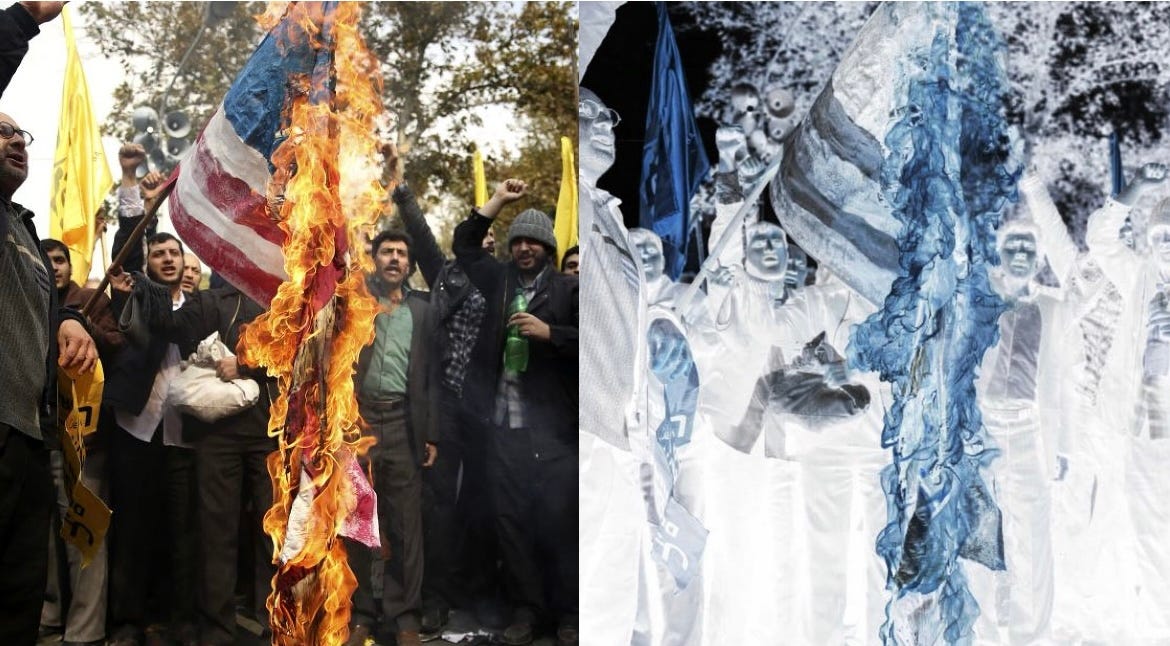
(Honolulu) Seeing a chicken run around after it has been beheaded is striking. The animal is effectively dead, but its headless body, while somehow aware that something is awry, has not conceded the fact.
So it may be with Iran as the United States once again bends over backward to offer a peaceful exit for a regime whose adherents would have been burnt at the stake by any decent church or mosque.
Iran’s navy and air force no longer exist as organized military forces. Their remnants may be able to get off a lucky shot here and there—similar to the Imperial Japanese Navy after its final general defeat at the Battle of Leyte Gulf in 1944—but such attacks are militarily negligible, even if they cheer America’s enemies in the liberal media and Europe and seem anything but negligible to those directly affected.
Iran agreed to a ceasefire but has broken it at times. President Donald Trump has responded in turn by blockading the export of Iranian oil and other goods. The clerical deviants who run Iran got an education over the weekend in Trump’s seriousness.
After six hours of repeatedly warning an Iranian blockade-running ship to turn back, the U.S. Navy disabled it with 5-inch cannon fire—the first surface-to-surface gunnery engagement by our sailors since 1988. Marines then boarded the ship, and now it is ours. Finders keepers.
The act itself was merciful. In World War II, the ship would have been sunk and its survivors left adrift. The Pentagon should consider more aggressive handling lest Iran place booby traps or its own commandos on its ships. Better for them all to go to the bottom than risk a single American serviceman.
Hopefully Iran realizes its sole economic and strategic lifeline—its ability to export about 1.6 million barrels per day before the war—no longer exists unless and until it accedes to every one of the demands Trump has articulated with the full support of U.S. allies in the Arabian Gulf like the United Arab Emirates.
But the Iranians, running around like a headless chicken, seem intransigent. At least some do. Depending on whom one consults, either the Iranians have decided not to negotiate with the United States or are set to meet a high-level American delegation in Pakistan on Tuesday. It is not entirely clear who is in charge of Iran. I guess we’ll see.

Trump has again threatened to strike Iran’s energy infrastructure. He would prefer not to do so, but such an act would produce military, political, and economic benefits. With Iran’s energy business eliminated and the Strait of Hormuz reopened, the oil-producing nations of the Gulf and the United States would benefit. U.S. oil production is near its all-time high at 13.6 million barrels per day. Prices consistently closer to an average of $70-75 per barrel—a bit above the $64 average price of West Texas Intermediate for the year prior to the war—would entice more U.S. investment in energy production and therefore more output.
Dropping sanctions on Russia would allow Moscow to return oil exports to prewar levels of 7.8 million barrels per day—about 0.7 million more than today. Removing all sanctions on Russia would allow this number to grow and help expand trade in Alaskan and Russian energy products through the Arctic, avoiding notorious chokepoints like the Strait of Hormuz (Arabian Gulf), the Suez Canal (Egypt), and the Strait of Malacca (Singapore).
The rest of the oil deficit, until it could be resolved by expanded U.S. production, could be made up by asking Saudi Arabia, the United Arab Emirates, and the other Gulfies—all governments with which Trump has great relationships—to go to maximum output.
U.S.-enforced tolls on the export of gas to China from Qatar—a mediocre ally that has sought to play both sides of any conflict involving the United States—could alleviate the higher cost of gasoline and diesel in America through transfer payments.
However, such an arrangement would still leave the remnants of an intransigent regime and nuclear-weapons related sites whose level of destruction is unclear.
Some hope the Iranian people will overthrow the regime and become chums of America, Israel, and the Gulfies—alleviating long-term worry about what is left of Iran’s nuclear program. That would be super, but it simply cannot be an assumption of U.S. national security policy. Recall that the Clinton administration declined to bomb North Korea’s plutonium-producing reactor in part because its officials incorrectly presumed the Pyongyang government would collapse amid famine in the 1990s.
The U.S. government today is also terrible at the political warfare we once employed to shape foreign political developments to the benefit of U.S. national interests. Subverting Iran’s government in particular was part of my 2013 book, “Smart Power: Between Diplomacy and War.”
At the time, I thought America and its allies could rediscover past achievements in upending adversarial regimes through nonviolent political warfare, in part by reforming institutions like the Central Intelligence Agency or reviving shuttered ones like the U.S. Information Agency, the Pentagon’s wartime Office of Strategic Services, or the British Political Warfare Executive.
I no longer do: twenty-five years after 9/11, Washington and other Western governments are clueless about identifying political Islam as the hostile upstream political force that animates our Middle East enemies and then adjusting policy accordingly. America’s taxpayer-funded democracy-industrial complex, including organizations like the National Endowment for Democracy, worries more about Trump than the mullahs who run Iran.
If we had the capacity to figure out this policy question, we would have by now. And if we cannot count on political means to control Iran, we must rely on military ones. Put simply, hoping for democratic transformations sometimes pays off in the future. But military force always pays off right now.
Unless Iran relents, Trump should consider the use of low-yield nuclear weapons in highly controlled circumstances to render Iranian nuclear sites inaccessible for a decade or two. He should also consider low-yield strikes on Iranian cities like Qom—the capital of Islamist ferment—if the alternative is indefinite warfare that puts Americans and our allies at risk.
A digression on nuclear-weapons design and its relevance to dealing with Iran:
The United States used two bombs against Japan to end the Pacific War, the lessons of which are relevant today.
The bomb we dropped on Hiroshima was based on the fissile isotope uranium-235. Manhattan Project scientists were confident enough that it would work—and concerned enough about the scarcity of uranium-235—that they did not test the design in advance. Its first use was on Hiroshima, and it yielded about 15 kilotons—the equivalent of 15,000 short tons of TNT. The device used a gun-type design that fired one subcritical piece of uranium-235 into another, creating a supercritical assembly and the ensuing explosion.
The bomb we dropped on Nagasaki was a more complex and efficient design based on the fissile isotope plutonium-239, which today exists in nature on Earth only in trace amounts. It must be bred in a reactor when uranium-238 captures a neutron and then decays through uranium-239 and neptunium-239 into plutonium-239. Construction of the Nagasaki bomb required the invention of implosion, since firing two plutonium pieces together, as with the Hiroshima bomb, would cause them to pre-initiate or fly apart instead of producing the intended nuclear explosion. The complexity of the design led Manhattan Project officials to order a test of the implosion design in New Mexico in July 1945 before it was used in combat the following month on Nagasaki.
Those two isotopes—uranium-235 and plutonium-239—are two of the few isotopes that can sustain a fission chain reaction because they can absorb a low-energy, or thermal, neutron and then split. Each fission event releases energy and additional fast neutrons, which can trigger more fissions under the right conditions. In a weapon, this can produce an extremely rapid, self-amplifying chain reaction that releases a large amount of energy from the atomic nucleus. (Two other fissile isotopes, uranium-233 and plutonium-241, are generally less practical for weapons production and long-term maintenance.)
This physics recap is relevant here because of the nature of the Iranian nuclear program. Iran said it needed the ability to enrich uranium for fuel for electricity-producing nuclear reactors—one that is in operation at Bushehr and others under construction there. This was an obvious lie. Iran already had a deal with Russia’s Rosatom to provide fuel assemblies and take spent fuel off its hands.
But Tehran said it needed its own ability to enrich uranium for nuclear fuel and all too many people played along with this fiction.
Enrichment means increasing the concentration of uranium-235 in uranium, which is otherwise mostly uranium-238. Today, this is done most commonly through centrifuge cascades. After milling and conversion, uranium is turned into uranium hexafluoride gas (UF6) and fed through a cascade, or series, of centrifuges. Because uranium-235 and uranium-238 differ slightly in mass, the gas streams separate incrementally, allowing enrichment to build gradually from stage to stage.
The big problem with Iran doing this goes back to the Hiroshima bomb: once a military has a sufficient quantity of uranium-235, it does not need much additional technical knowledge to make a crude nuclear weapon. Mastering implosion, neutron initiation, and extremely accurate timing and design required for an efficient plutonium bomb are not necessary for a crude uranium bomb that could level Dubai, Riyadh, Tel Aviv, or Washington.
Iran’s claim that it needed enrichment for energy or medical uses was always mendacious. As noted, Russia was willing to provide the nuclear fuel assemblies and take them back, which would have meant Iran could forgo sanctions that have cost it billions of dollars per year. Furthermore, commercial electricity-producing reactors typically use low-enriched uranium containing about 3-5% uranium-235, with most of the balance being uranium-238. Iran’s decision to enrich uranium to 60% or more has no realistic civilian electricity-producing purpose—it was meant to bring Iran to the brink of being a nuclear-weapons power.
Trump hates the idea of nuclear war and more nuclear-armed U.S. adversaries. His recent comments show his disappointment with the refusal of then-president Bill Clinton to use military means to prevent North Korea from becoming a nuclear-weapons power. Bubba should have bombed North Korea’s plutonium-producing reactor at Yongbyon but didn’t.
Trump is also very much a product of the 1980s, when he achieved wealth, power, notoriety, and a sense of civic responsibility. He demonstrates this in the importance he places on well-managed relations with Russia and China, and in leader-to-leader summits that allow leaders to cut through red tape. One such example was the breakthrough by then-president Ronald Reagan and Soviet leader Mikhail Gorbachev in eliminating an entire class of deployed nuclear weapons in Europe. These were hallmarks of the 1980s.
You may also recall the 1980s as the decade in which the American public was regaled with media like “The Day After,” a horrific movie about the consequences of nuclear war with the Soviets that aired on ABC in 1983. I was nine years old at the time and, in accordance with the “anything goes” standard for what Gen X was allowed to watch (I’m grateful, if bemused), saw the whole horrifying product in its network debut. Reagan watched—he noted in his diary that it made him “greatly depressed”—and Trump probably did too, given its high ratings.
Would a president who hates nuclear weapons, and who authorized force against Iran to prevent Iranian nuclear terrorism, be willing paradoxically to use nukes against the deviants who run Iran should they persist in their intransigence?
He should consider it seriously.
The United States and Israel have acted repeatedly to degrade Iran’s nuclear-weapons capabilities. They did so last year in June 2025 and have done so again in the current war. But unless Iran is forced to allow the United States to seize what Trump correctly calls “nuclear dust,” something must be done.
That dust is probably still in the form of uranium hexafluoride gas (UF6). The centrifuges, which are sensitive pieces of hardware, are probably destroyed, but UF6 is usually withdrawn from them when not undergoing enrichment and stored in cylinders. UF6 is heavier than air and is solid at room temperature under ordinary conditions. There may be cylinders of this nuclear “dust” buried beneath U.S.-Israeli bombing sites in Iran. While difficult, it may be possible for Iran to excavate and reconstitute the UF6 and resume enrichment and bomb assembly. Maybe.
How can these locations be rendered inaccessible to humans so the material remains entombed? The answer is low-yield nuclear weapons whose radiological effects, when properly employed, are intense and localized.
Rendering a site inaccessible through calibrated contamination is harder than one might imagine. It is illustrative to again return to America’s own nuclear weapons history.
In our second postwar nuclear test, “Crossroads Baker,” fired underwater in the lagoon at Bikini Atoll, a shot based on the same plutonium implosion design as the 21-kiloton Nagasaki weapon produced, through neutron activation, the isotope sodium-24, which was intensely radiologically dangerous. So far, so good, if one wants to render a local geography inaccessible. But the isotope’s half-life is a mere 15 hours—hardly enough to render a location off-limits for long.
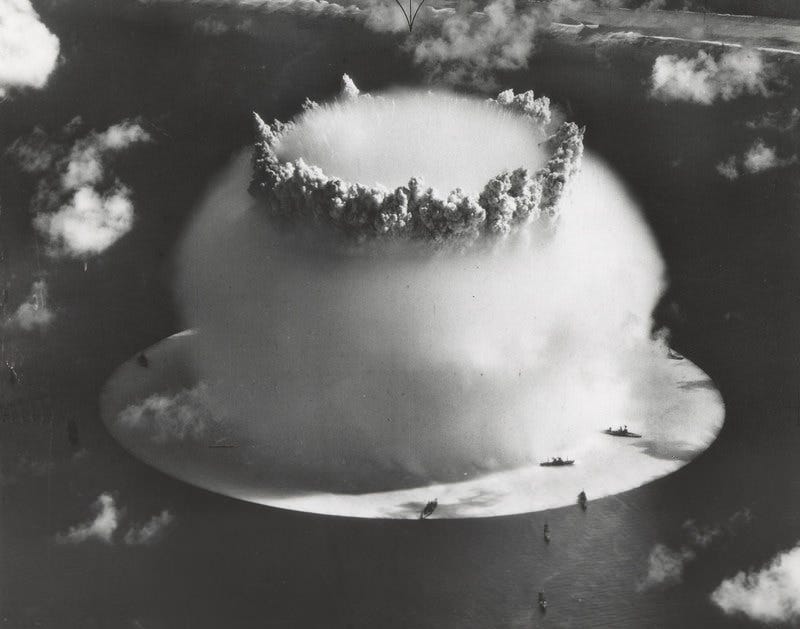
More instructive was “Castle Bravo,” fired at poor Bikini in 1954. While the distinction was lost on its victims, Hiroshima and Nagasaki were relatively “clean” shots in that they detonated about 1,900 and 1,650 feet above ground, respectively. Their fireballs never reached the ground and therefore limited contamination. The primary destruction and death were products of the bombs’ intense light, heat, and shock waves. For radiation victims, whether they suffered acute radiation sickness immediately or developed cancer years later, the culprits were prompt gamma rays and neutrons at the instant the bombs exploded, along with some residual fallout—not long-term exposure to massive local fallout of the sort seen after near-surface shots.
Castle Bravo illustrated the other end of the spectrum. In a lesson that shows why the United States should resume underground testing of novel nuclear-weapons designs today to ensure safety and reliability, the bomb’s yield was much larger than expected. Atomic Energy Commission scientists designed the bomb as one of the earlier thermonuclear designs that used the intense x-rays from a fission primary to compress and ignite the bomb’s secondary stage. They planned for the isotope lithium-6 to absorb a neutron and produce tritium, an isotope of hydrogen, to provide the main fusion fuel (hence the name “hydrogen bomb”). It did.
However, lithium-7, the more abundant isotope and one expected to be largely irrelevant on the millisecond timeline of the reaction, turned out to be quite relevant. At the high neutron energies produced in the initial reaction, lithium-7 also contributed to tritium production. As a result, a shot that scientists expected to yield about 6 megatons actually yielded 15 megatons. That was about 1,000 times the energy yield of the Hiroshima bomb.
The large yield was not the only significant factor. Unlike Hiroshima or Nagasaki, Castle Bravo was not an airburst whose fireball never touched the ground. It was fired just above ground level and entrained an enormous amount of pulverized coral and other matter into its fireball, which reached temperatures of tens of millions of degrees and produced a cloud that rose to about 130,000 feet. As a result, the cloud carried a great deal of radiologically dangerous weapon debris and fallout, including fission products such as isotopes of strontium and cesium. Additional fallout was created when prompt neutrons from the shot were captured by otherwise nonradioactive elements and made them radioactive.
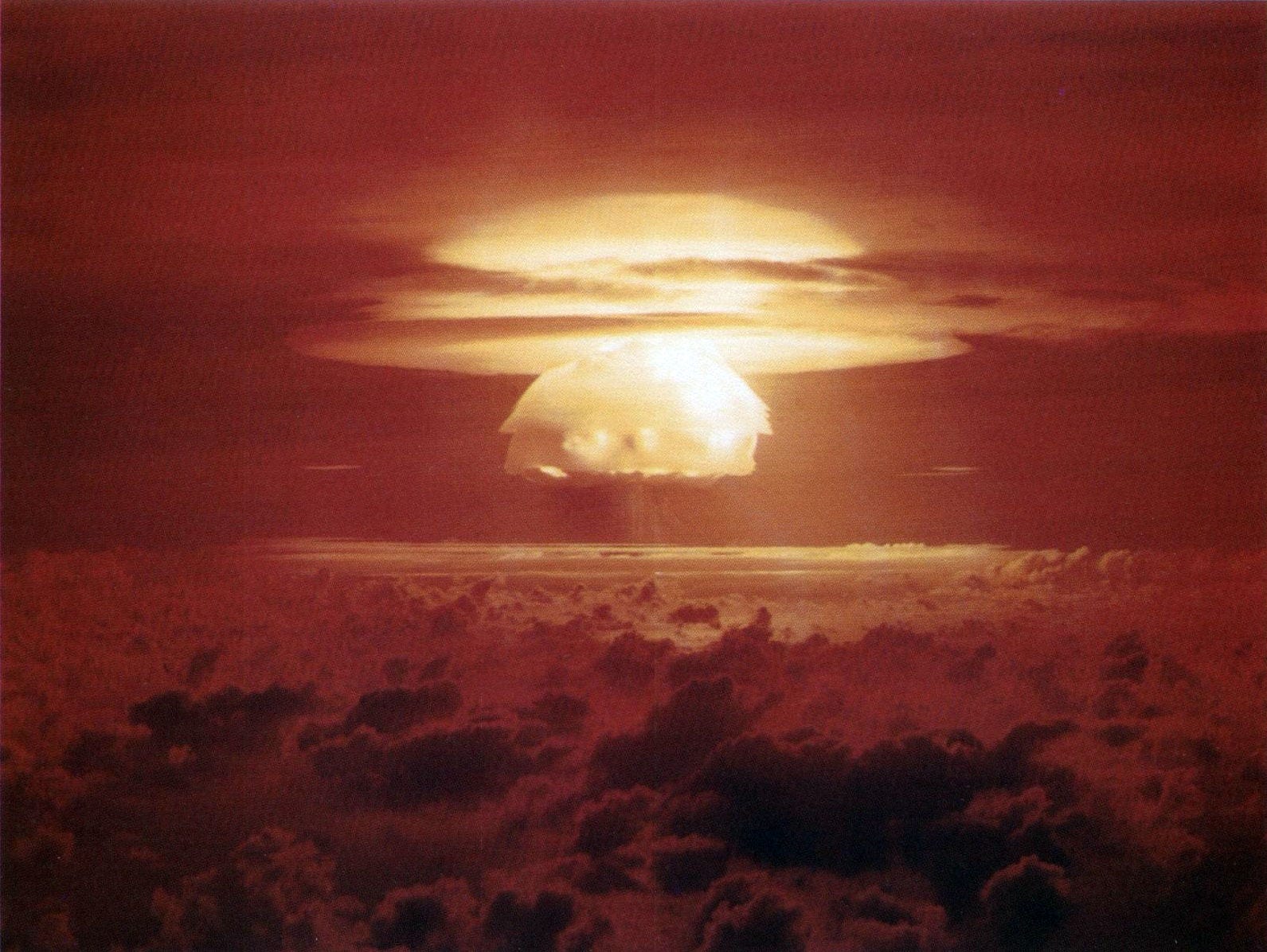
The smaller Bikini Baker test produced radiation that was localized and intense but didn’t last long enough to deny an area to an enemy. Castle Bravo produced enormous and lethal fallout that spread over a wide area. Rendering Iran’s nuclear weapons sites off limits would require something that draws lessons from both.
Trump, like any president, ought to have a solution at hand. Unfortunately he does not, thanks to the anti-nuclear arms-control priesthood that prevailed for much of the late Cold War and the sissy Congress. During the Cold War, scientists like Edward Teller—father of the hydrogen bomb—conceived of “salted weapons” that would use radiological contamination to render select locations difficult for an enemy to access.
The most practical concept was to jacket a thermonuclear weapon with cobalt-59, which would absorb a neutron in the explosion to become cobalt-60, a strong gamma emitter with a half-life of just over five years—ideal for rendering a site off-limits for 10-20 years. (After one half-life, half of the original quantity of the isotope remains undecayed, and half has decayed).
Trump’s friend Elon Musk might be about to engineer a quick fix, given his acumen in applied physics. A cobalt jacket added to an existing bomb would have to receive ample neutron bombardment before the bomb disassembles—close enough to be activated, but not so close that it interferes with the bomb’s existing physics package.
Otherwise, given how long it takes the federal government to acquire novel weapons—and given that the Department of Energy and the Department of Defense are already failing to field new nuclear systems for an era in which U.S. ICBMs are no longer invulnerable and hypersonic weapons are changing the reality of war—something more immediate would be required.
An interim solution would be for Trump to order a series of low-yield bombings of Iran’s primary nuclear-weapons sites. America’s venerable B61 nuclear bomb is suitable, as some variants have supported ground-burst or limited earth-penetrating detonation—preferable because they would entrain and contaminate as much local soil as possible while maximizing local dispersal and minimizing spread beyond the nuclear sites. Furthermore, the bomb family includes variable-yield options (“dial-a-yield”) that, depending on the variant, range from less than one kiloton up to about 50 kilotons for the B61-12 (recall that Hiroshima was about 15 kilotons). Several dozen set to the lower end of that range, perhaps around one kiloton, could be used in shotgun patterns on Iranian nuclear sites. They can be delivered by U.S. stealth B-2 and F-35A aircraft, against which Iran has no defenses.
While not producing the ideal medium-term radiological poisoning of a cobalt bomb, the fission products from a set of regular thermonuclear weapons configured to maximize local contamination should render the sites difficult to access for some time. The most important Iranian nuclear sites associated with uranium enrichment—Natanz, Fordow, and Isfahan—are conveniently located in central Iran, far from neighboring countries.
One does not consider using nuclear weapons lightly, even at low yield. As the B-52 pilot character played by Slim Pickens in the 1964 dark comedy doomsday film “Dr. Strangelove” said, “I reckon you wouldn’t even be human beings if you didn’t have some pretty strong personal feelings about nuclear combat.”
This is true. The use of nuclear weapons for the first time since 1945 would make previous freakouts about Trump seem small. Financial markets would plummet and energy markets would spike—but only temporarily.
Eventually, new and welcome realities would become apparent: that Iran will never have the bomb, that Iran will no longer threaten anyone, that seeking nuclear weapons actually decreases a nation’s safety, and that the nuclear club is permanently closed to new entrants. Furthermore, such an action would demonstrate U.S. will and likely bring an end to combat and an end to U.S. and allied casualties.
Trump should consider this option and begin test-bombing Iranian nuclear sites with conventional bombs to convince Tehran that he is thinking it over.
"He should consider it seriously."
And regretfully decline to carry out such an action.
Your essay is informative and you have compelling arguments, but the next country to deploy nuclear weapons, must necessarily become a radioactive wasteland in perpetuity, at the combined agency of all nuclear powers in coordination.
The temptation toward a radioactive efficiency in ending the war started by the Iranian theocratic monsters all those decades ago, is understandable but unconscionable. There has never been any moderation of industrial warfare, once the Rubicon of initial deployment has been crossed, with one exception; nuclear bombs.
There is a reason for that, and a very good reason indeed; it is a question of "opening Pandora's box" once again, and this time would be the last one in human history.
I remember the kitchen table conversations during the Iran hostage situation, all those years ago. Plenty of "turn that desert into glass" sentiment, always followed by a wistful "too bad we can't."
Best to resign oneself to being wistful. If the "madcap mullahs" start it with dirty-bomb suitcase nukes, we will be more than wistful, we'll be enraged and in mourning, and return fire in kind, but we cannot be the ones to open Pandora's box. That last peek inside, was enough to understand what was (and is) at stake.
Perfect. That would allow Russia to attack Europe with nuclear weapons.