

Vance Misled Trump About Iran
Make-believe about moderates in Iran returns to U.S. policy.

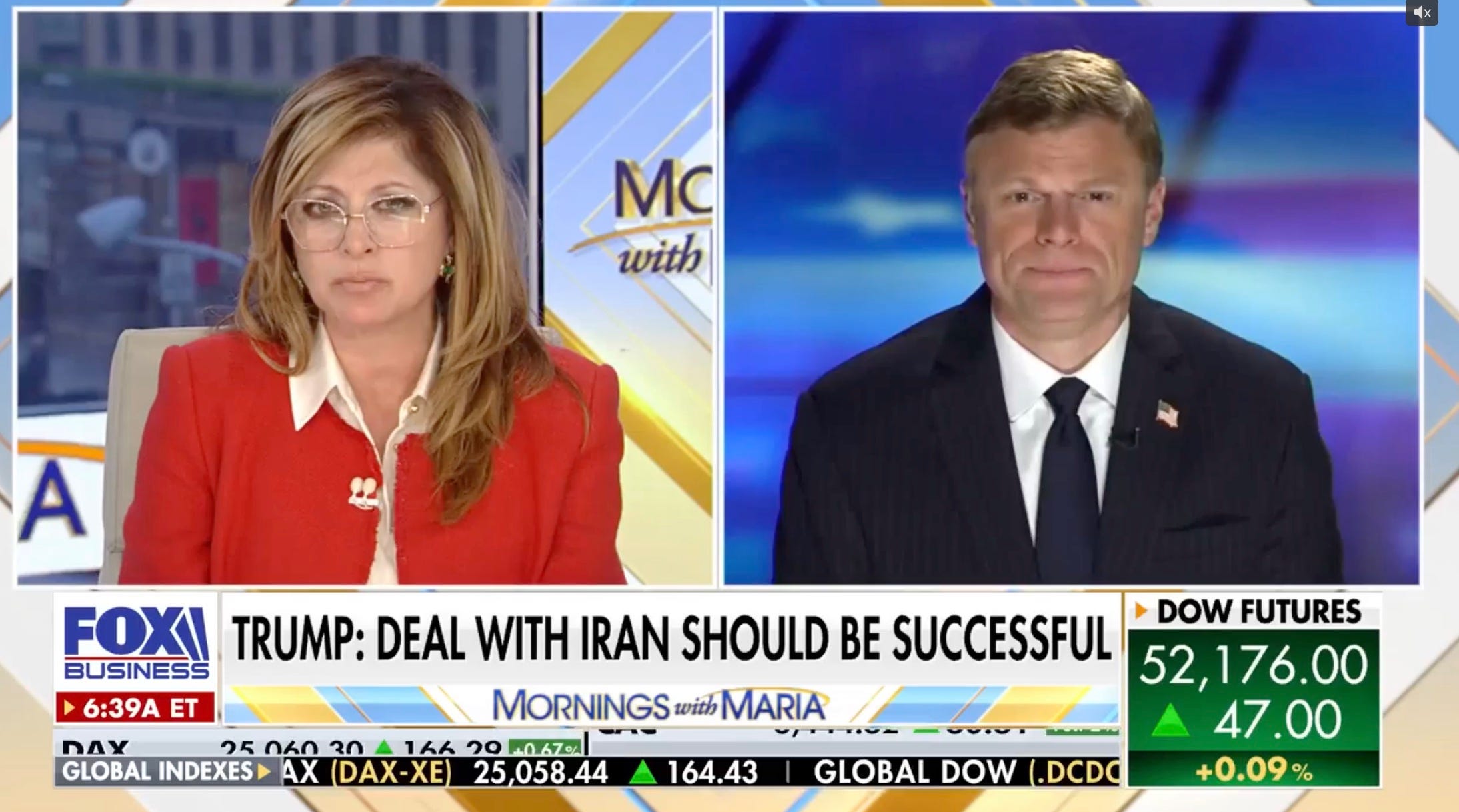
Vice President JD Vance took President Donald Trump back to the future with a nuclear deal based on the flawed assumption that incipient moderation will occur in Iran with a little payola and love.
The fiction restores a make-believe assumption about the Islamic Republic that has contributed to decades of bad U.S. policy, and that Trump himself previously discarded.
In an interview with Megyn Kelly yesterday, Vance said:
So the way that I think about it is there’s sort of a fork in the road in this entire relationship with Iran. For 47 years, we’ve obviously had basically a terrible relationship with Iran. They funded a lot of terrorist organizations. There’s obviously the nuclear issue that’s been in the background, going back well before Donald Trump even got on the political scene. And here’s where we are right now... they are in a position where what they’re saying is that they want to make long-term commitments to the United States and to the Gulf Arab countries to change their relationship.
In an interview with Fox News, Vance said of the Iranian leadership, “I think that they see there’s a real opportunity here to turn over a new leaf so long as they do the right thing.”
Vance added further about his journey of discovery:
You talk about hardliners and moderates. What’s fascinating to me about their system is that we’re seeing even people that I would have assumed are hardliners who are kind of saying, ‘Maybe it was a mistake for us to do the things that we’ve done over the last 40 years. Maybe we should turn over a new leaf in the relationship with the United States of America.’
Vance then boasted of a “strategic opening to Iran” and celebrated the emergence of “more moderate elements” in the Islamist regime. He spoke of moderates interested in “a political discourse with the United States.”
Actually, he didn’t. Those last references come from criticism of flawed official thinking cited in the Tower Report, which was commissioned after the Reagan administration was caught scandalously trading arms for hostages with Iran in the 1980s. The trade only encouraged Iranian misconduct.
Since that time, across both Republican and Democrat administrations, there have been experts who perceived moderates in the Iranian regime who just needed a little support and coaxing to swing Tehran into a friendlier disposition toward the United States.
President George H. W. Bush saw a pragmatist in Iranian President Akbar Rafsanjani, winked at Iran in his inaugural address by suggesting “Good will begets good will,” and later observed that “the Iranians were trying to be helpful.”
That was the same year that Iranian proxy Hezbollah executed U.S. Marine Lt. Col. William Higgins. Also that year, Iranian actors conducted assassinations in Austria, Cyprus, and the U.A.E., and set off a bomb in Saudi Arabia.
Next, the Clinton administration saw a big opening with the election of Mohammad Khatami in Iran, who professed on CNN to want a “dialogue among civilizations.” President Bill Clinton was “captivated” by the “apparently like-minded” Khatami. Clinton wrote to Khatami assuring him that the United States had “no hostile intentions” toward the Islamic Republic.
During those breezy post-Cold War 1990s, Iranian operatives conducted assassinations in Argentina, Italy, Pakistan, Sweden, and Turkey. They bombed the Khobar Towers in Saudi Arabia, killing 19 U.S. servicemen and wounding hundreds of others.
The habit of seeing moderates where none existed took a hiatus of sorts after 9/11. But the mirage made a big comeback when President Barack Obama took office.
When Hassan Rouhani became Iran’s president in 2013, an Obama official forecast “a more moderate foreign policy.” Two years later, Obama approved the Joint Comprehensive Plan of Action, which began with paying Iran $1.7 billion in physical cash and ended with Iran using advanced centrifuges allowed under the deal to enrich uranium.
That agreement came in the wake of years in which Iranian operatives had killed or wounded thousands of Americans in the Middle East and planned a mass-casualty assassination of an ambassador in Washington--an attack luckily thwarted by the Drug Enforcement Administration.
A year after taking office, Trump withdrew from the Iran deal in 2018, remarking that the agreement was “defective at its core.” He then ordered a “maximum pressure” campaign against Iran and dispensed with the long-held mirage of moderates in the Iranian regime forever on the cusp of power.
In his second term, Trump resumed pressure on Iran and ultimately ordered military action. The “reformist” mirage was suppressed, helped into remission by the regime’s decision to kill thousands of its own citizens who were engaged in peaceful protest.
But now Vance has brought it back and made it a key assumption and single point of failure in U.S. policy toward Iran--effectively forcing Trump’s hand.
Vance has also misled the public and members of Congress, which in turn has forced Trump’s hand to restate false claims.
For example, Vance told Fox News that “Iran doesn’t get a dime from anyone if they don’t change their behavior.” In fact, Iran reasonably expects at least $14 billion in prompt payola from Qatar. Tehran later expects $300 billion from U.S. allies.
Today, Reuters reported that a “senior U.S. official” who was “speaking on the condition of anonymity” briefed the media about the plan Vance will sign with Iran as early as Friday. The official on the call was in fact Vance. He confirmed the worst of what has been suspected about the agreement with Iran, which is still officially concealed from the American public, including:
Paragraph 1: Forcing Israel and Lebanon to cease action against Hezbollah, effectively providing a lifeline to the American-killing Iranian proxy.
Paragraph 5: Recognizing new Iranian control of the Strait of Hormuz, a worse situation than existed at the beginning of the war. Text: “The Islamic Republic of Iran will conduct dialogue with the Sultanate of Oman to define the future administration and maritime services in the Strait of Hormuz.”
Paragraph 11: Immediate payola for Iran, absent any action, in an amount far greater than the $1.7 billion Obama flew to Tehran. Text: “The United States of America undertakes to make fully available for use the frozen or restricted funds and assets of the Islamic Republic of Iran.”
The Vance deal will kick off a 60-day period (likely indefinite) to negotiate unresolved issues. Trump himself has ensured that Iran will have the upper hand in these talks through his characterization of the cost of failure. On Wednesday, in a meeting with Egypt’s president, Trump complained to a reporter about skeptics of the deal:
You know, the stupid people want to have a worldwide depression, and they’re stupid people. So you can only go so far. You drive somebody into the ground, and a lot of bad things happen… the Strait would never open, because they don’t like floating billion-dollar ships up and down a strait when there are rockets flying over them and mines all over the place… It wouldn’t be open for a long time.
Being a stupid person, I am left wondering why Trump authorized a war on Iran with no plan to keep open the Strait of Hormuz. The U.S. military has expected and prepared for such a contingency since at least 1979, when the Islamist regime came to power.
Usually reliable sources on Capitol Hill report that the administration believed it had “really good” intelligence that Iran would not close the Strait. Hopefully Vance or another administration official can explain to us stupid people why they were caught off guard and tanked confidence in Trump’s otherwise strong economy when what everyone else expected to happen actually happened.
Until then, we the stupid can only gawk slack-jawed at the 3D diplomacy taking place, lacking the capacity to understand genius.

Once the mid terms are done I'd advise the Iranians to be very compliant.
I think there has to be a balancing act in negotiations. In the 1980’s Reagan took out half of Iran’s navy. We didn’t hear from them for 10 years. Trump took out their entire navy with the exception of the small boat which provides some tactical advantage but no strategic value. We have demonstrated our technological superiority over Chinese and Russian defensive systems and we can strike them with impunity.
We could have reopened the straits but at what cost of American lives. We could have demanded unconditional surrender but how long and how much manpower would be to manage the country and how many American lives would have been lost in an insurgency. Another 20 years Afghanistan fiasco?
We are allowing them to use their own money with restrictions and other gulf countries will have to provide the rest. Do you think they will release money to a country that was hostile to their interest if they think it will be used against them. They have skin in the game. That’s new.
We had a 100 day war not a 20 year cluster. Gas never got much over $4 which it did many time during the Obama administration, when $4 was $4.
Is it a great deal. No. But do we still have leverage. Yes. Heck the b52’s bombed them from the US. Heck how long after the Berlin Wall did the Soviet Union fall. You never how things will play out. Their economy is a shit show and they are running out of water. They may need Israel to manage their water systems like they did when the Shah was running the show